When I first told my dad I wanted to join the Peace Corps, I remember my dad's response exactly:
"Well, if you go somewhere I haven't been before, I'll come visit you."
Now, that isn't why I picked Guyana (I picked "send me anywhere") but it worked out in my favor, because although he's been all over South America, he'd never been to Guyana.
His trip started out on the wrong foot, because we got trapped in Georgetown longer than I'd anticipated, and the longer I'm here, the less I like Georgetown, so I didn't want to waste any of his trip there. BUT since we were stuck anyways...
We headed over to the National Park I wrote about in another post, and spent HOURS feeding more than half a dozen manatees (I think at one point there were about nine, though they kept submerging, so it's hard to be sure). Despite the fact that I'd told Dad it was still the dry season, it proceeded to rain for about three days straight, because of course it did.
Next was the real test of adaptability: Dad couldn't get on the flight down to Lethem. That left me with only one option: putting him on that horrible overnight bus. That trail is murder, with potholes big enough to swallow up a herd of goats (probably) and the drivers smash you in with about 600 other people until you can't breathe, and then you stay like that... for anywhere from 13 to 18 hours (just of the drive. that doesn't include the several hours you sit parked so the driver can nap). I couldn't even go with him, because PC won't let volunteers take that bus anymore, because it can be a bit dodgy. So I had to put my dad, on his second day in the country, on that bus by himself, and promise I'd pick him up when he got to the North Rupununi. If he got to the North Rupununi.
He made it out alive, and I was waiting at the other end in Annai, and brought him home to my house. My students were wicked curious about him, and skipped right over to introduce themselves, which was shocking to me, because it took months to get even a "hello" when I got here! Then he proceeded to pass out in my hammock for basically the rest of the day. I can't blame him: that's my favorite thing to do too.
FINALLY we got to the actual plan, which was a trip up (down? Who knows. I'd have to look at a map, and... yeah, I'm not going to do that right now. I should probably know that by now, since I've lived here for almost two years at this point...) the river to an eco lodge in Rewa with two other volunteers (Steven and Thomas). I'd tried to explain the two boys to Dad so he'd know who was coming with us, and his only response was "Will I like them?" *looks at picture* "Probably not." (He did.) Our boat driver bailed on us at the last possible second, but luckily for us, Steven's host dad Eli, who has family in Rewa, agreed to take us. Better yet, when we got there, someone I'd met back when I first came to Region Nine for my site visit turned out to be a tour guide with the lodge, and he remembered me, and so he and Eli took us fishing.
Eli fishing from the boat
Vivien teaching my dad their way of fishing
The piranha Thomas caught
Dad all proud of his killer fish
Piranha
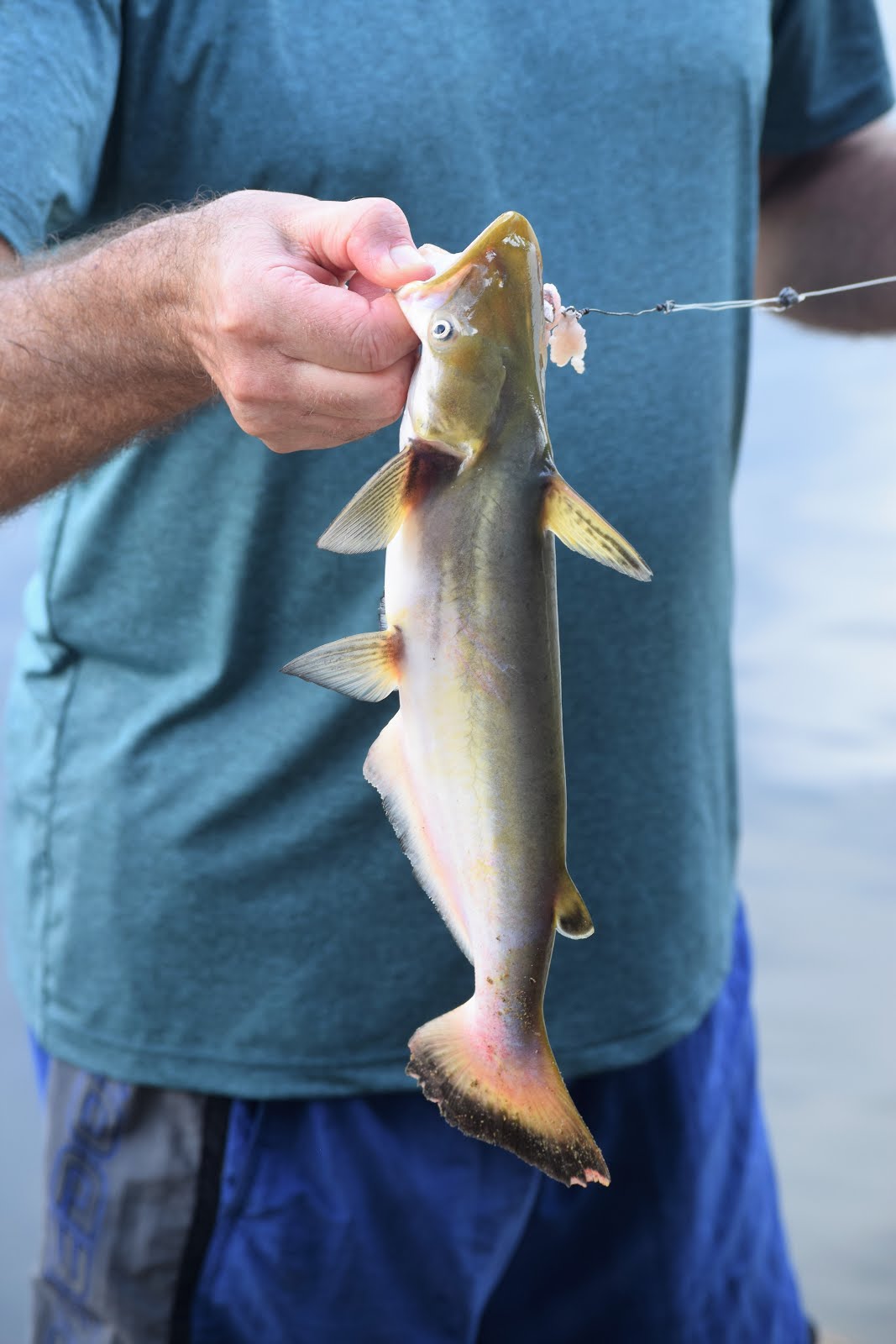
Also an out of season catfish, which Vivien got all excited about.
I took about eight million pictures, mostly from the boat, and the boys had fun fishing. My dad got his wish and caught a piranha, so really, what more could you ask for from a trip to South America?
Vivien caught a crab, covered in tiny baby crabs (look closely) by sticking his hand into crevasses underwater, which is more than a little insane, considering what else is in that water.
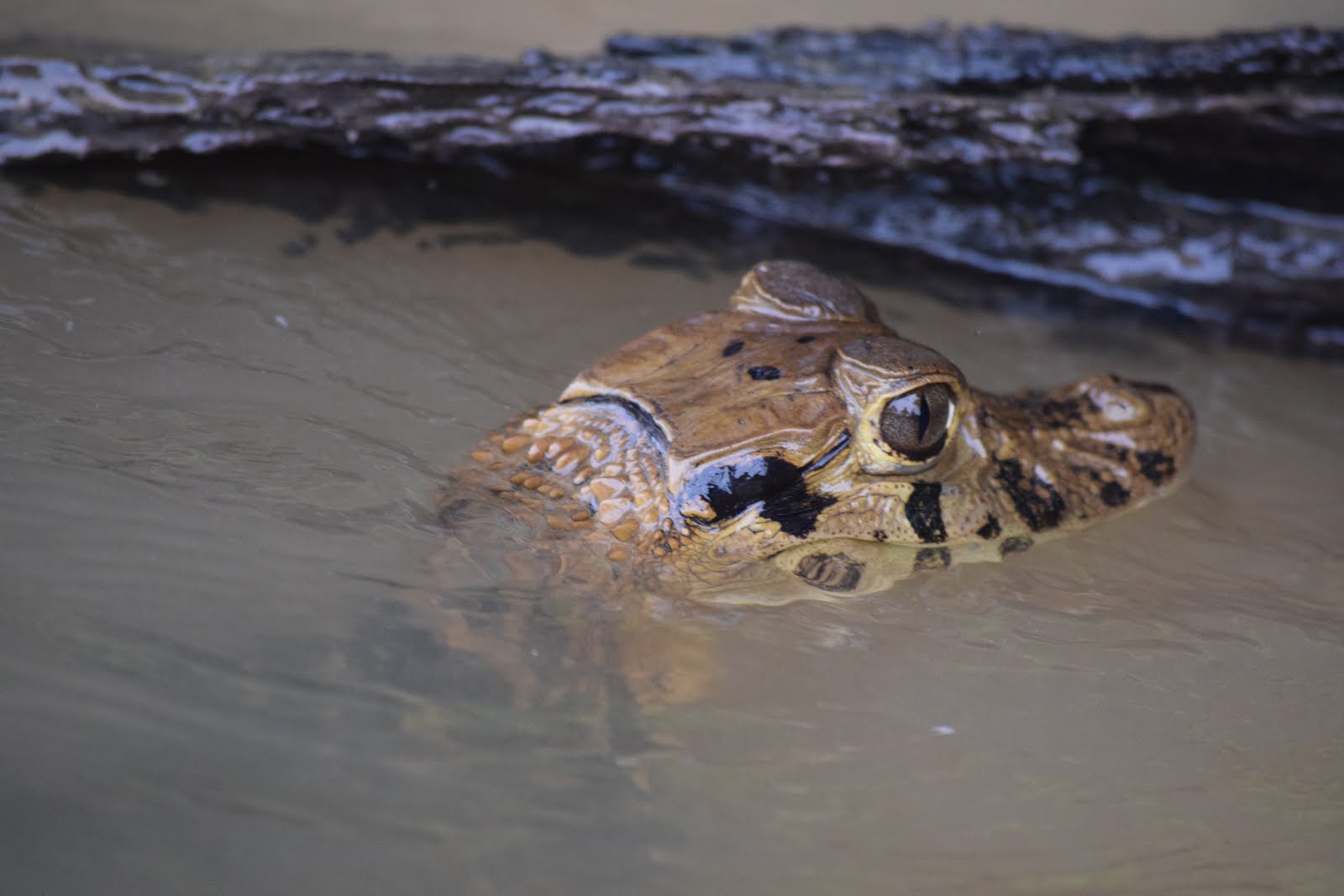
This. This is also in that water. That's a "vampire fish"
Lots of these in the water
Awww, look how cute he is
Oh look, there's a bigger one
And another one...
Wait.
Wait, no.
Don't pet the caiman, even if you can reach them.
Not everything wants to eat you though. There were plenty of birds, and even some adorable (and very noisy) Giant River Otters. I took hundreds of pictures, and it will take me FOREVER to go through them all, but I've picked out a few to show off.
Just chillin' on the beach. I like this bird. I feel like we could hang out.
Okay, so I will have to post pictures of the boys later (I know I have them, but I've procrastinated long enough posting this!) So I'll just leave you with this:
If you're considering the Peace Corps Guyana Environmental program (of which my cohort was the first) you may have seen this video made by PCV Don Henegger:
So what is Peace Corps really like? Well, it's not really like that. It is dirty and frustrating, and incredibly overwhelming, especially at the start. It's also pretty amazing, but really: I can't stress the dirt and the sweat enough. Ever seen Pigpen from the Peanuts comics? You're going to be him. With sweat. Just buckets of it.
So for those of you who are, like I was about 16 months ago, wondering what to cram into your two suitcases, and what the $&%# you just got yourself into, this post is for you:
First of all, the clothes. I know they send you a list, but it's a bunch of nonsense.* You're going to be wearing the same four outfits every day. Every single day. I am not exaggerating this. If you're coming in for Health or Education, you'll need those to be business-y clothes. If you're coming in for Environment... well, you're in a tough spot. You'll need business clothes for the official PC stuff, like the two months of PreService Training, and then IST (InService Training), MST (MidService Training), any committee meetings, and COS (Close of Service), but hardly ever the rest of the time.** Split your clothes up between your two suitcases, and put your business-y stuff in your carry-on. That way you can live out of your carry-on during staging without having to open your carefully mashed big suitcases and having to repack them all over again. Also, if the airline loses a bag, you're not pantsless for the first two months while they hopefully find it and send it.
Important clothes:
Girls: Bring a slip. Seriously. All those pretty skirts and dresses that are totally opaque? Surprise! The sun will burn right through them giving everyone a fantastic view of your butt. Yoga pants or leggings. The mosquitoes, caboras, and sandflies are all on a mission to destroy your legs. Pants are your only safety.
Skirts. The list says to bring a bunch. Really, you don't need that many, and you can get them here if you want. One or two (if you like skirts) will serve you just fine. While women may be expected to wear skirts in other countries, you'll be fine in pants here. Shorts. Hell yes. You will be living on the surface of the sun. If you're white, you'll be getting way too much attention no matter what you wear. Rock those shorts anyways.
Pants. Bring a pair of jeans, and a pair of light, loose pants. Think hippie pants. You can buy more jeans when you get here if you find you need them.
Undies. Bring all the undies you can. Stuff a pair in every nook and cranny of that suitcase. Bras. Bring like 3: one to wear, one to wash, and a sportsbra. Bonus advice: leave a box and some money, so if you lose a bunch of weight like I did and none of your bras fit anymore, you can order some online and have a friend or family member ship them to you. The bras you can buy here are akin to the Madonna cone style from the 80's, and filled with so much padding you can use them as an emergency flotation device in case your canoe flips. DO NOT BRING PADDED BRAS. Seriously they soak up soap suds like a sponge (because they basically are a sponge) and when you're trying to do laundry by hand and have to rinse those out, you will NEVER GET ALL THE SOAP OUT and it will annoy you like nothing else. Also, they will soak up so much boob sweat you will never be comfortable again (remember: padded bra = sponge.) Even bras you didn't think were padded are too padded. Find unlined ones, then try washing them in your kitchen sink with bubble bath. Then remind yourself that you're going to be doing that in a bucket for the next two years, and there's a good chance you won't have running water. Then throw it down in frustration and go find a bra with even less padding.
Shirts. Lightest, thinnest material ever. Cotton is too hot. Your summer teeshirts are too hot. Honestly naked is too hot, but that might be going a bit far. You're going to swim in sweat on a daily basis. You need shirts that won't show that, and that will dry really quickly before it starts raining again during the wet seasons, which will inevitably happen right after you hang your clothes up, and then again about ten minutes before you're about take them off the line again. Note: I know they say avoid tee-shirts, but that is nonsense. I wear tee shirts and tank tops (with a shoulder cover thingy) pretty much every day. One THIN sweatshirt. I know it contradicts what I just said about how you're going to be living on the surface of the sun and melting on a near-constant basis, but you're going to adapt (to where you still melt, but you get used to the feeling of sweat trickling all over your body like some gross fountain) and then one evening you'll find you're actually chilly. Don't panic. You'll dig this thin sweatshirt out, and you'll be fine.
Dress clothes. Bring ONE nice dress/outfit. That's for Swearing In, weddings, and whatever other dressy thing you get into. Think "Sunday best" type thing, rather than "wedding guest" and you'll get way more use out of it.
Shoes: Flip flops are going to be what you wear 99% of the time. They say not to pack them because you can get them here. You CAN get them here, but what are you going to wear for the first two months of PST before you get to site and can actually buy stuff? Flip flops don't take up much room. Bring them. You're going to wish you did. Bring sneakers for working out or running. Ballet flats are going to get destroyed, but they don't take up much room, so whatever floats your boat. A hat.
Things that they tell you, that seriously, believe them: A belt. You're going to lose weight the first few months you actually get to your site. Like, scarily. Your butt is going to disappear. Not in a good way, but in a "crap, my shorts won't stay up anymore and my bra is now half empty, so why do I still have this pudge around my stomach? That seems unfair" kind of way. During PST you might actually gain weight, but almost everyone suddenly drops when they get to their sites. Don't worry: it usually doesn't last. Once you get adjusted (about 6 months in) you'll start evening out and with all that bicycling you'll do if you're in a hinterland site, you might actually start finding muscles you didn't know you had. Veggie peeler and can opener. I don't know what they have against can openers and veggie peelers here, but no one has them or uses them, so trying to find one is like searching for the holy grail. Here everyone just stabs everything with knives. It's certainly possible to open cans and peel veggies with knives, but if you're at all accident prone, do your fingers a favor and just toss one in your suitcase.
Nice bed sheets. You'll be able to find sheets at your permanent site, but you'll need these for your training site, anyways. Besides, it's not like you won't be using sheets for the next two years. Splurge on microfiber or something. Remember: you want something that can stand up to hand-scrubbing, and which will DRY QUICKLY outside, hopefully before it rains again. Cotton feels nice, but you will soak it with sweat, and it will never dry, and might even grow mold. Super gross.
What they don't mention: Quick dry towels. They pack smaller, dry quicker, and you'll use them all the time whenever you visit another PCV at their site. The downside: they do start to smell. You really have to scrub those things and make sure they dry completely. Still, totally worth it. You can buy normal bath towels here. Instead, just pack a quick dry travel towel. I got this one and it's been perfect. A travel mosquito net. I know they say don't bring a net because they give you one, and that's true, but do you know what a pain in the arse it is to take down and set up a net? A big one. You're going to want to travel, you're going to want to visit other PCVs, and you're not going to want to take down/set up every time, or haul it around (the net they give you is pretty big). Get a small net you can toss in a bag and set up quickly. I brought this one and have used it more often than I can count. It's light, fairly small to pack, and sets up quickly. Added benefit: if you live in a cabora infested site, those little blood suckers can zip right through the mosquito-sized holes in the official PC net, so doubling (or tripling) up your nets during cabora season is your only chance to actually save your skin. PC staff will tell you that's not true, but trust me on this one. They are vicious.
Make up. I don't know how they do it, but some PCVs wear make up every single day. I think if I could be bothered to put it on, it would melt off in the first five minutes of my day, but hey, whatever makes you happy. I did bring some for special occasions, and here's the advice I'm going to give you regarding make up: the lighter the better (liquid anything is going to make you feel like you've smeared hot pond slime on your skin.) Bring enough of your foundation or powder or whatever to last you two years, because the lighter your shade of skin, the less likely you'll ever find a match here.
Sunscreen. They tell you not to bring any, because they supply it, and that's true, but it's basic, regular sunscreen that feels gross on your face. Go ahead and bring that nicer lotion you have for your face. It's the little things that make life more bearable. Comfort items. Peace Corps will give you a little graph about what your mental health and enthusiasm is going to be like over the course of your two years. Most of you will look at it and go "yeah right" but I'm not kidding when I say that it is dead on, for almost everyone. Something stupid and little that makes you happy is worth stuffing inside your ridiculously overweight suitcase. Examples I've seen: swear word coloring books, little stuffed animal birds that chirp, a map of your home state, that silly nonsense teeshirt you love... seriously, anything. Bring that one reference letter that went on and on about how awesome you are. Bring a baseball, or a hackeysack you can throw at the wall whenever you get really pissed off (speaking of which, can someone send me a baseball or a hackeysack? I need something to throw...). I brought a chinese hand fan which I use EVERY DAY. Not only does it cool me down, but it's a great way to disguise fidgeting, and also hides my face when I can no longer control my facial expressions (those PST trainings can be brutal to sit through). Another brilliant volunteer brought these "cool towel" things and holy crap am I jealous (again, if you're wondering what to send me, send me those!) Swim shorts/swim suit. Yes it's true that people here don't swim in swimsuits, but in their clothes, (or for guys, in their undies) but ladies, recheck that note about washing your bras. Having a swimsuit on under your top, or shorts that dry quickly, will make swimming much more fun and less of a "aww man, I'm gonna have to wash these AGAIN" thing. A portable hard drive. I know it's expensive, but you're going to want it. Not only for the eight billion pictures you'll take, but PCVs share all sorts of resources and entertainment, and even workouts that way. I watched about a hundred videos of this one being flung at walls and held under water and still working, so I figure it can handle Guyana. A medical ID bracelet. Even if you don't wear one normally, if you have any sort of allergy or condition, this is a good idea. In the States, it's mostly in case you can't speak for yourself. Here if you get that bad, you're pretty much hosed anyways. It's more because a lot of doctors here come from Brazil or Cuba, and are a little shaky on English. If you've got a condition, they can read your bracelet and look it up easier than trying to figure out your silly accent. (True story here.) This one can be engraved on the front with relevant medical info, and on the back with your name and "Peace Corps Volunteer" in case you either lose it, or they have to identify your body.
Forget the nalgene bottle. Collapsible reusable water bottles may be slightly less hardcore, but they pack way better.
PC tells you to bring cards or watches to give as gifts. Watches are dumb, cards are dumb (okay, no, cards are fun, but still), and they can get both here. Bring State-specific goodies to hand out instead. Your host family and counterpart can sport shirts with your local team or your state motto or your university or whatever. It'll make them feel special, cheer you up to see on random days, and remind them of you long after you're gone. Bring size adult small unisex ones. If it doesn't fit your host parent, it'll fit a sibling or whatever. Dry sacks. These are so underrated. You're going to be traveling out of site at least once per month (usually). You hinterland volunteers will use that trip to find internet somewhere, which means you're going to be lugging your phone and laptop with you. There's a whole season they call "rainy" and they mean it. Protect your most expensive stuff! Toss it in a dry sack. Now you don't have to worry. Paracord and duct tape. There isn't much you can't do with those in a pinch, and the duct tape you get here isn't very good. A multitool/pocket knife. This (and a cutlass, which you'll buy here) are basically going to be your whole toolkit for the next two years. Get one you can beat the crap out of. Get two so when someone eventually walks off with yours, you're not all sad.
Bring a camera. You're coming into untouched rainforest, and some amazing savanna.
Tips, tricks, and little extras:
They say to bring shampoo and soap, to last you until you get settled somewhere. Save on space, weight, and packaging by packing solid shampoo and soap bars. My hair lands about at the bottom of my shoulder blades, and one of these lasts me two to three months, with no need for conditioner.
If you're bringing socks (to go with those workout sneakers) opt for Darn Tough socks. I've worn out shoes faster than these socks. They are nearly impossible to destroy, which is good, because all of your clothes here will get destroyed. ...Except your socks, I guess.
Get a travel water filter. Peace Corps gives you a huge filter for your house, but sometimes you'll visit places and the water just seems a little ... iffy. This one is tiny, and can be used with the collapsible bottle that comes with it, or a coke bottle, or whatever you have handy. Throw it in your go-bag. Space-saver vacuum bags. There are ones that don't actually need a vacuum even, so you can reuse them after PST to move all your stuff to site again.
Don't bring a yoga mat. A bunch of volunteers do, but you can get them here, and why waste the valuable packing space? Workout bands and jump ropes are great things to bring if you're planning to work out, though.
A surge protector. Some of the electrical work you'll encounter (if you're lucky enough to have current) will be a bit dodgy. One of these is way cheaper than a new computer.
Aloe. If you've got fair skin, you're going to burn. Despite all the sunscreen. It's going to happen.
Fellow PCVs: feel free to leave comments if you've got more advice!
*Peace Corps Staff want it noted that their list is NOT "nonsense" and also my complaints are based on the old list (which is the one I got. You guys get the new and improved list, which they'd also like me to mention that I personally DID send suggestions in for, so...)
**Peace Corps Staff want it noted that since the framework has been revised so that incoming Environmental Volunteers will be working mostly in schools, so they will need business-y clothes as well.
On December 11th, sometime around 7 AM, Leticia Pablo died.
She was a very dear student, and was one of the first that I got to know when I moved to Bina Hill. She was bright, warm, talented, and gracious, and will be sorely missed.
Ahhh Midservice: That point about a year in where they haul in what's left of your cohort and examine the shattered remnants of what used to be Peace Corps Volunteers.
We're the first environmental group in Guyana, and in some of the most remote locations. None of us have regular email access, and about half of us don't even have cell service at our sites. My site, which is one of the easiest to travel from, still takes an inordinate amount of prep and about two days to get from site to Georgetown.
With this in mind, Peace Corps emailed us our travel arrangements.
No calls were made until the day before some volunteers needed to actually find a ride for the first part of the trip out.
It's a good thing we're pros now. Just a few rolled eyes and some good-natured grumbling (from my fellows, who have better temperaments than I do), and everyone made it out on time.
I, on the other hand, almost didn't make it. After a distressing morning of no-transportation-available which left me barely making it to the airport only 15 minutes before the flight left, I was in one of those moods that leaves small children fleeing in terror, and causes wise adults to clear a very large path around me. Then we had our medical exams. Oh goody.
The good news is I'm probably not dying. At least not from TB (which was a legitimate concern. It's not rare around me at all). The bad news is staff stomping into the exam room with paperwork while you're half-naked on the table is also not rare. This did not improve my mood.
Luckily the Guy 29 group is well used to my gremlin-mode, and never fails to cajole me out of it. Plus there was a pool. That always helps.
I know Peace Corps is hoping I'll go into detail about all the training sessions they had, and all of the other technical stuff at the Midservice "trainings" but that's probably more boring to read about than it would be to write about, so I'm going to do us both a favor and instead post silly pictures.
Lance telling some crazy story
The boys enjoying the pool
Jon. I'm pretty sure this is just his normal look.
Our very own "Creation of Adam"
I won't tell you how long we spent trying to get that shot perfect. I'm perfectly happy letting you assume we nailed it perfectly on the first try.
Dylan sporting his glorious mutton chops. Despite our many entreaties, he shaved them off after this picture.
After our IST several months before, the boys decided not to shave again until Midservice. Since Kirsten didn't want to get left out of the fun, I styled her hair into the manliest beard ever.
The Beard-y Pic. Also, the cover of my next album. Also, I need to start a band...
Dylan, Thomas and I made a quick daytrip out to visit our first host families, from back before we moved to our sites.
Jennie and one of her grandbabies
New-mom Orlenna napping with her baby
Of course I dragged Daniel to the creek again.
He started it. I just finished it.
Thomas was with us, and at one point I became slightly concerned, because the creek is fairly isolated, and I looked up to see this:
Yep. This is definitely a murderer.
Luckily most of the time he looks more like this:
This guy probably wouldn't murder anyone. (You can read his version of events at tomstravellog.wordpress.com . If he did murder someone, you'd find it there.)
So there you have it. Six of us have survived a whole year, and they're keeping me in high spirits with their shenanigans. The best part about Midservice was having all of us in one place to hang out for awhile.
Bina Hill Institute is a strange place. It's a weird sort of tertiary school, but instead of higher education, it's meant to be a second chance for hinterland Amerindian kids who either failed out of, didn't finish, or maybe just never got to go to Secondary School. It's supposed to teach them both traditional Amerindian skills, and prepare them for jobs in the environmental sector in things like forestry, agriculture or tourism. It's set up like if someone was trying to copy an American tech school, but had never actually seen a tech school.
Basically, it's a great idea, but very poorly executed. Don't get me wrong, I love the concept, I love my job, I love the location, I love the students, but what Bina Hill was set up to do, it isn't actually doing. Classes are often interrupted or don't run at all, and due to a number of factors (lack of resources being a big one) most of the learning they do is in a classroom, staring at a chalkboard.
I started with the negative, but there are still some things the students ARE getting. In their second year, they do internships at tourist resorts in the region, which gives them practical experience, something to put on their resume, and great connections with possible employers. They also are doing really well with their work in the agriculture class, now that they finally have a new teacher (the previous one left partway through the prior year, so there was no agriculture teacher at the agricultural institute for the better part of a year). While they prepare the vegetable beds and plant the fruit trees, they learn about composting and soil maintenance. While they raise chickens, they learn about livestock maintenance and cost-of-production calculations. When they go out into the forest to cut sticks for the climbing plants, they learn about local trees and best practice clearing.
There is a learning curve though:
Ana is not quite sure how she feels about these chickens
Conway is stoked to try though
Gaibert, our most efficient chicken-killer
While some students did the slaughtering, others plucked and washed
What food looks like when it doesn't come in supermarket packaging
Shena and Mervin preparing to go into the forest
Grayson carrying out freshly cut poles for the climbing plants
Bora plants (which look similar to string beans) and student-made trellis
The agriculture teacher giving instructions to Shena and Fenella
It's not all hard work though. Since part of the idea is to preserve culture, the students learn traditional dancing and crafts that are dying out.
The end of the Cockroach Dance which always ends in giggles
A student starting either a basket or a farine sifter
One of our more advanced weaving students added a beautiful color pattern to his
They also do wood carvings, but those pictures will come later.
One of the most recent additions to the curriculum is a Home Economics class, which focuses a bit on the usual things like nutrition and cooking, but focuses more on the hospitality side of tourism with table settings, serving, and menu planning.
Every once in a while though, the Home Ec class makes delicious desserts, which they sometimes share
These kids work really hard, and I'm very proud of them.
Since I can't post pictures or videos of the "demonic fits" the students of Bina Hill were having, here's a photo of Thomas looking the part (actually, he was just innocently sleeping on a plane, but he admitted it looked rather funny and told me I could use the picture here).
Apparently every year in October, demons possess the students, starting with the girls. They start having "strange seizure-like fits, super-human strength, are insensible and don't feel any pain, scream about hallucinations, run out of doors into nowhere, and coordinate actions with others afflicted."
Now I can't speak to past cases, nor to ones I didn't see, but none of that was true of the ones I did witness. What was it really like? If you've ever seen a six-year-old throw a tantrum for attention, well, you've seen demon possession.
In any case, a pastor was called in and performed exorcisms on all the girls. When that didn't work, several were sent home to "recover." Here's hoping it worked, because it interrupted classes for far too long two years in a row now.